
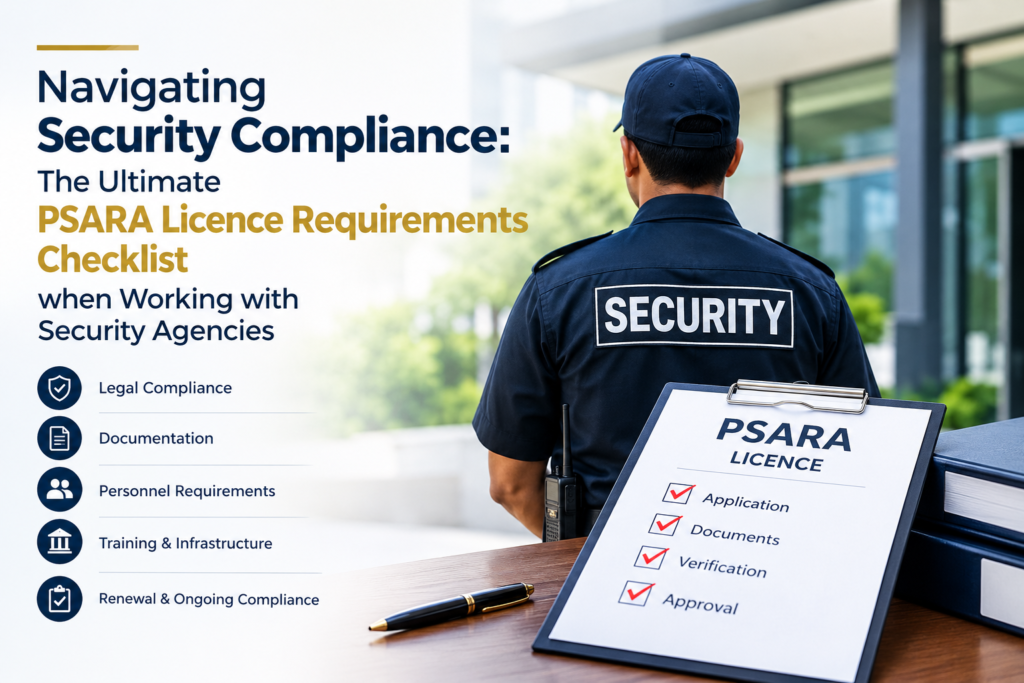
Partnering with a private security agency in India is far from just an operational choice. According to the Private Security Agencies Regulation Act (PSARA) of 2005, working with an unlicensed security agency is against the law and involves severe statutory punishments. For facility managers, executives, and entrepreneurs, ensuring that your security partner meets all the regulatory requirements is the essential step towards the security of your enterprise.
Whether you set up a security agency yourself or do a due diligence check on your service provider, this guide will walk you through the required obligations and give you a practical PSARA licence requirements checklist.
Why PSARA Compliance Is Critical for Your Company’s Security
According to PSARA legislation, standardising security training, background checks, and other aspects of the private security industry is necessary. Choosing an unapproved provider creates multiple risks:
- Legislative Risks: Partnering with non-compliant agencies leads to fines, audits, legal and liabilities associated with the statutory non-compliance under the contract labour legislation;
- Vulnerability to Internal Threats: Uncertified companies often lack the police verification, leaving facilities vulnerable to security and theft problems internally;
- Non-professional Guards: Most of the unlicensed guards lack appropriate training in crisis control, fire response, and other emergency situations;
- Fiscal Risks: Any agency that doesn’t pay attention to the statutory requirements like EPF, ESIC, or minimal wages may bring the liability claim from the hiring company.
The Master PSARA Licence Requirements Checklist
For obtaining and maintaining a PSARA licence by the state Controlling Authority, the business should provide the necessary documents. Here is your checklist of required information:
- Legal Entity and Registration
Your business needs to be registered in India according to the country’s legislation with the required object clauses:
- The Certificate of Incorporation for Private Limited/LLP or proof of registration of partnership deed/proprietorship.
- Memorandum of Association (MOA) and Articles of Association (AOA) explicitly allowing private security operations.
- Permanent Account Number (PAN) Card of the business entity.
- Goods and Services Tax (GST) Registration Certificate.
- State-registered Shops and Establishment Act Licence.
- Personal Details of Directors/Applicants Identification (KYC)
Directors, partners, and proprietors need to pass the required background checks and satisfy the eligibility criteria:
- Government Photo ID (PAN card, Aadhaar card, passport, or voter ID).
- Proof of residential address of all directors/owners.
- Police Verification Certificate (PVC) indicating the absence of criminal background.
- Educational Certificates.
- An affidavit of non-conviction to comply with the PSARA eligibility criteria.
- Business Premises & Infrastructure Verification
It is necessary to have a real operational office located in the chosen state:
- Lease/Rent Agreement or Property Ownership Deed.
- Negative No Objection Certificate (NOC) in case of renting.
- Utility Bill (electricity or landline phone bill) as the proof of address.
- Mandatory Security Guard Training Tie-up (MoU)
According to PSARA, all guards need to take special training classes:
- Memorandum of Understanding (MoU) signed with the approved security training institute.
- Proof of completion of the following courses: physical conditioning, crowd management, weapon handling (armed guards), and emergency first aid.
- Employee Welfare and Statutory Registrations
Guards should be insured and covered by the required employee benefits:
- Registration in Employees’ Provident Fund (EPF).
- Registration with Employees’ State Insurance Corporation (ESIC).
- Contract Labour License (in case of using more workers than the statute permits).
- Guidelines for Uniforms & Visual Identity
In order to prevent the visual identification of your guards with police or army members:
- Official uniform pattern and design with badge sample to be submitted for state approval.
Quick Reference: Compliance Audit Matrix
|
Category |
Primary Document / Requirement |
Risk Prevented |
|
Legal Status |
Certificate of Incorporation / GST / MOA |
Unlawful business operations |
|
Background Checks |
Police Verification & Affidavits |
Deployment of unverified personnel or leadership |
|
Tactical Readiness |
MoU of Approved Training (160-Hour Standards) |
Poor crisis management and site vulnerabilities |
|
Labour Compliance |
EPF, ESIC & Minimum Wage Adherence |
Principals’ employers’ joint-liability claims |
|
Visual Protocol |
State-approved uniform pattern & badges |
Public impersonation of law enforcement agencies |
The Awadh Group Standard: Perfect Compliance Excellence
Maintaining the PSARA licence requirements checklist is essential, but making sure that all those requirements are fulfilled on your own takes much effort. Partnering with a trusted industry leader will help you avoid these difficulties.
Founded in 1994, Awadh Group holds the valid PSARA licences in all the states where it operates and keeps the highest standards of statutory compliance. Securing critical assets in BFSI, IT parks, airports, hospitals, and industrial complexes, Awadh Group combines statutory compliance with operational efficiency:
- AETA Elite Training: Our security guards go through the 160-hour programme at Awadh Elite Training Academy (AETA) that includes physical readiness, fire safety, and crisis management training by defence veterans.
- 100% Police-Verified Personnel: Each of our 146+ offices has guards with complete police clearance and background verification.
- Totally Statutory Compliance: Awadh Group covers all the EPF, ESIC, and statutory wage compliance issues to make its clients worry-free.
- More Than 30 Years of Experience: Having 60,000+ trained professionals and a 100% client retention rate, Awadh Group delivers reliable, compliant asset protection.
Case Study: Eliminating Statutory Risks for a Major Commercial Park
Client Profile: Multi-tenant commercial IT park in North India covering 2.5 million sq. ft., with over 30 corporate enterprise offices.
The Problem
During a regular state inspection, the facility management found out that the security service provider had an expired state PSARA licence and lacked police verification records for almost 40% of deployed manpower. The principal employer was at risk of facing statutory penalties, legal notices, and reputation damage.
The Awadh Group Intervention
Awadh Group stepped in to conduct a seamless zero-downtime transition of services:
- Comprehensive Audit Against PSARA License Requirements Checklist: Awadh Group conducted a full audit on the basis of the PSARA license requirements checklist and ensured 100% statutory compliance with all legal eligibility, state PSARA license and 100% police verification records of all new manpower.
- Deployment of AETA-Certified Guards: Within 72 hours, Awadh Group deployed 150+ guards certified by Awadh Elite Training Academy (AETA) with proper emergency handling.
- Statutory Compliance: Documentation pertaining to EPF, ESIC and labour law regulations was provided on one centralised portal.
The Outcome
- 100% Regulatory Compliance: The IT park was successfully cleared of labour and state security audits without a single compliance observation.
- Zero Joint Liability Risk: Complete compliance of wages and insurance kept the facility management safe from any legal joint liability risk.
- 35% Reduction in Incidents: Well-trained staff enhanced access control and prevented perimeter entry by unauthorised personnel within 60 days.
Get Protection for Your Company with Certified Security Services
Your organisation must comply with security requirements without compromise. Partnering with an ISO-certified and veteran-driven company with full compliance to the PSARA licence ensures the safety of your manpower and property 24×7.
Request a free security audit today and get your premises protected with certified security.
Frequently Asked Questions
Q: Are PSARA licences valid in all states of India?
A: No. PSARA licences are issued by individual state-controlling authorities. Security agencies running operations in various states should have separate and valid PSARA licences for each individual state.
Q: For how long is a PSARA licence valid?
A: The validity of a PSARA licence is usually 5 years (1 year in select states).
Q: What are the risks associated with hiring non-compliant security service providers?
A: Engaging with an unlicensed security agency puts your organisation at risk of statutory penalties, sudden business closure and legal joint liability risk.